


THE MEDIA OPERATORS IN TUSCANY. A quantitative analysis of recent developments in radio, television and publishing
Report prepared by Local Global sas, supervised by M. Mariani and N. Sciclone, with statistical assistance from V. Patacchini.
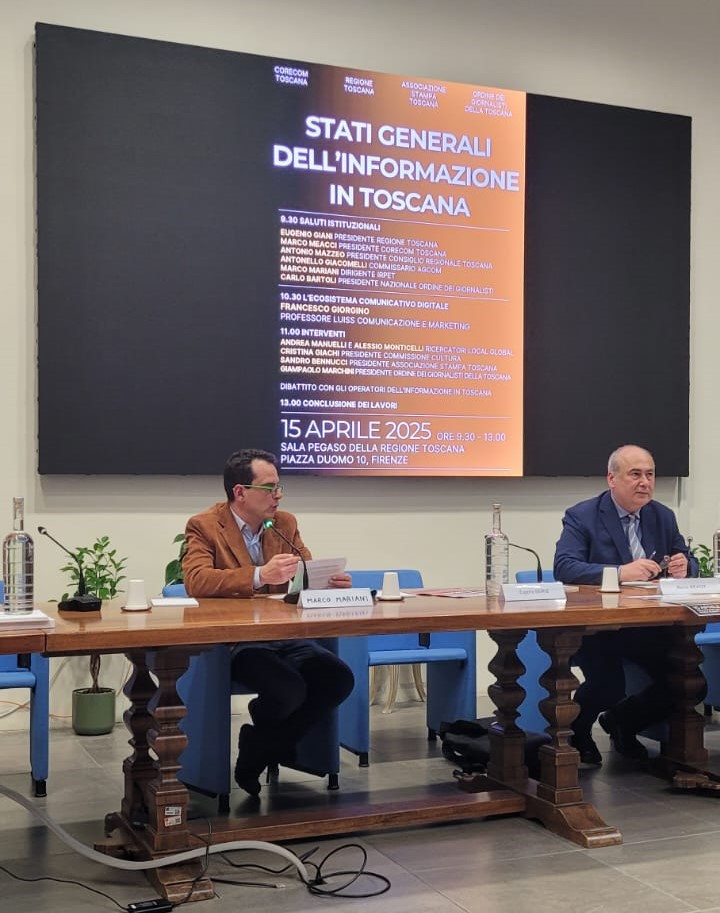
This work is part of the institutional activities commissioned to IRPET by Corecom Toscana of the Regional Council of Tuscany.
The report was drafted by Local Global sas, with the contribution of IRPET in terms of layout and supervision by Marco Mariani and Nicola Sciclone, as well as statistical assistance from Valentina Patacchini.
We would also like to thank Dario Caserta (Research Department – Pistoia-Prato Chamber of Commerce) for his statistical assistance with regard to Infocamere-CCIAA data.
Responsibility for the individual sections is divided as follows: Andrea Manuelli, Introduction and Section 2.1; Alessio Monticelli, Section 2.2 and Chapters 3, 4 and 5.
We would like to thank Corecom Toscana and Dr Giacomo Amalfitano for their collaboration.
This report presents the results of research on information operators in Tuscany. As in previous editions (e.g. 2006, 2011 and 2018), the research was commissioned to IRPET by Corecom Toscana. The current edition focuses on leveraging existing quantitative sources in order to understand recent developments in the sector, as well as to explore the economic mechanisms of value creation and employment development and its characteristics.
The Corecom of Tuscany has commissioned IRPET (Institute for Economic Planning of Tuscany) to conduct an analysis of information and publishing operators, with the aim of assessing the performance of this sector in our region.
The objective of this study, namely to update the regional picture of the sector by understanding its trends with particular attention to critical issues, is achieved by analysing several complementary sources which, taken together, provide an overview of key aspects.
Following this introductory Chapter 1, various data sources are used to focus on different aspects of the sector and obtain as complete a picture of it as possible.
In particular, Chapter 2 will describe and analyse the size and evolution of the sector, using two very different but in some ways complementary sources: 1) the ROC archive, managed by Corecom Toscana, in which operators register and deregister in accordance with legal requirements; 2) the Chamber of Commerce register, which, although created as an administrative source of data, is widely used for statistical and quantitative analysis. The variables taken into consideration are companies, local units and employees.
Chapter 3, on the other hand, focuses on the economic analysis of operators, seeking to identify certain key aspects such as productivity/profitability and the contribution of labour to the creation of added value, based on Istat’s ASIA archive.
Chapter 4 focuses on employment, moving from an aggregate analysis of the phenomenon to a detailed look at workers in the sector, highlighting their characteristics and their employment relationships in terms of job classification and contracts.
Finally, Chapter 5 concludes the report by highlighting the most significant results that emerged from all the analyses undertaken and drawing conclusions from these reflections.
You might also be interested in...
Research by E. Conti. Survey conducted by the Center for Tourism Studies. Statistical analysis by M. L. Maitino
Report edited by G. F. Gori, coordinated by P. Lattarulo, in collaboration with the Regional Public Contracts Observatory

Report edited by E. Conti
Annual Report edited by L. Ghezzi and N. Sciclone


