


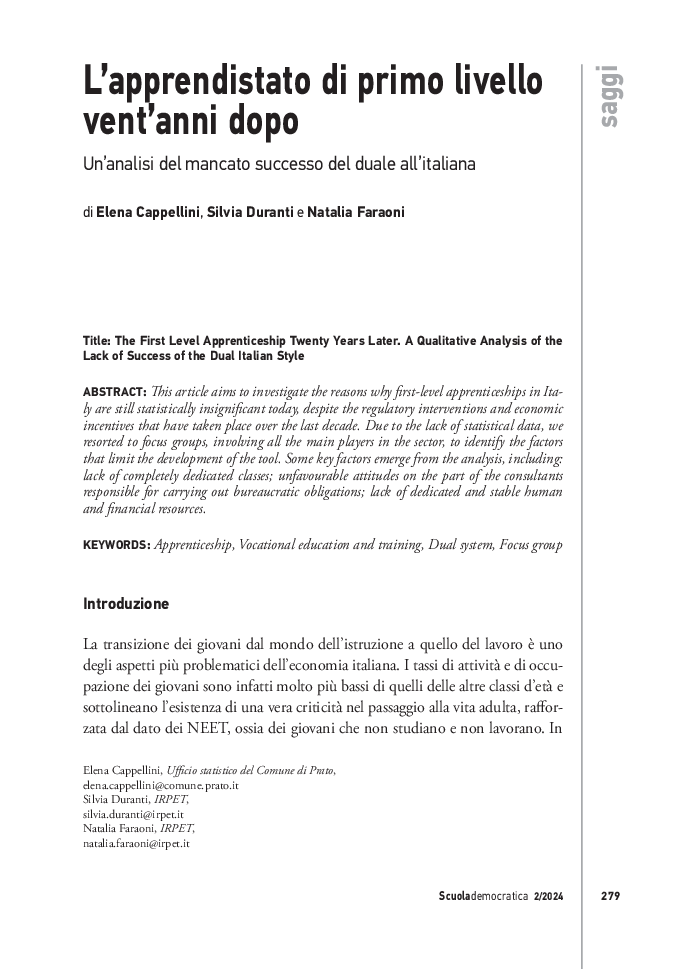
The first-level apprenticeship twenty years later. An analysis of the lack of success of the Italian-style dual system
By E. Cappellini, S. Duranti e N. Faraoni
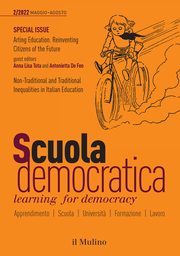
Article published in Scuola democratica; Learning for Democracy – Fascicolo 2/2024, maggio-agosto by Elena Cappellini, Silvia Duranti and Natalia Faraoni
Doi: 10.12828/114729
This article aims to investigate the reasons why first-level apprenticeships in Italy are still statistically insignificant today, despite the regulatory interventions and economic incentives that have taken place over the last decade. Due to the lack of statistical data, we resorted to focus groups, involving all the main players in the sector, to identify the factors that limit the development of the tool. Some key factors emerge from the analysis, including: lack of completely dedicated classes; unfavourable attitudes on the part of the consultants responsible for carrying out bureaucratic obligations; lack of dedicated and stable human and financial resources.
You might also be interested in...

Articolo pubblicato su International Journal of Automotive Technology and Management - Vol. 26 n. 3 - a cura di E. Alberti, L. Piccini, T. Ferraresi e R. Paniccià

Article on European Sociological Review edited by C. J. Gil-Hernández, D. Vignoli, R. Guetto, M. L. Maitino, L. Ravagli

Article on Scienze Regionale 2/2026 edited by T. Ferraresi, S. Iommi and L. Piccini

Chapter published in the volume "Students: inequalities and inclusion" by S. Duranti e F. Bogazzi


