


REPORT ON TOURISM IN TUSCANY. The Economic Outlook for 2025 and the First Quarter of 2026
Report edited by E. Conti

For the tourism sector, 2025 marks a phase that differs from the period immediately following the pandemic. The exceptional “rebound” is followed by more moderate growth—selective and influenced by geopolitical, economic, and climatic factors. Globally, international tourist arrivals will reach approximately 1.52 billion, representing a 4% increase over 2024 and a 3.7% increase compared to 2019. Europe remains the world’s leading destination, with over 790 million arrivals and 3.8% growth, while Asia-Pacific and Africa show more dynamic trends, linked respectively to the normalization of Asian travel flows and growth in North Africa. The international outlook is therefore positive, though less straightforward: demand remains resilient, yet it is unfolding against a backdrop marked by tensions in the Middle East, rising energy prices, higher airfare costs, and tourists’ increased focus on value for money.
International forecasts for 2026 indicate growth in arrivals of between 3% and 4%. However, uncertainty is higher than in the previous two-year period. Geopolitical instability can have a twofold effect: on the one hand, a partial reallocation of travel flows toward European destinations perceived as safer, including Italy and Tuscany; on the other hand, a slowdown in demand—especially for long-haul travel—due to rising transportation costs and reduced purchasing power. For Tuscany, this means it is in a potentially favorable position, thanks to its international reputation, perceived safety, and the strength of its regional brand, but it is also more exposed to fluctuations in foreign markets and travel costs.
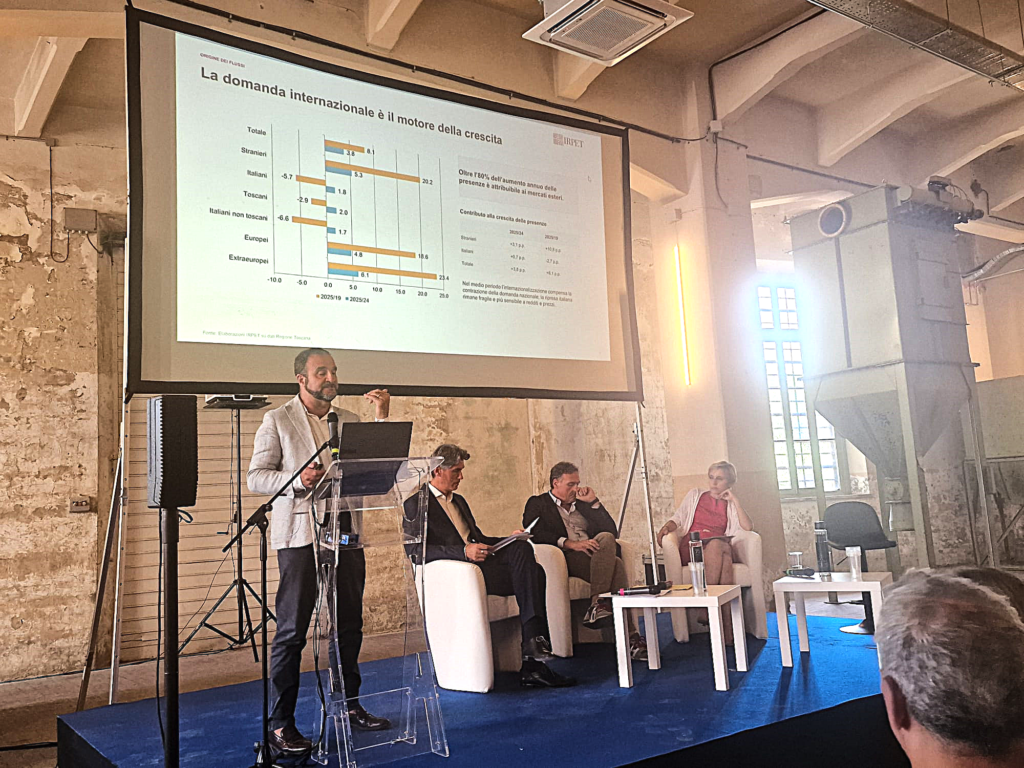
From a national perspective, the most significant figure is not so much the crisis in Italian demand as its structural weakness relative to the international component. In 2025, the number of Italian visitors to Tuscany will begin to grow again, but only by 1.8% compared to 2024, and will still remain 5.7% below 2019 levels. Non-Tuscan Italians are down 6.6% compared to pre-pandemic levels, while Tuscan residents are down 2.9%. In the first quarter of 2026, signs of recovery are finally evident in the domestic segment as well, with Italian visitor numbers up 2.6%, but the picture remains mixed: visitor flows from Central Italy and, to some extent, from the North are growing, while those from the South continue to decline. The situation in Tuscany should therefore be interpreted as growth driven primarily by international visitors, with domestic demand recovering but still fragile and more sensitive to prices, disposable income, and the quality of the offerings. (…)
The data used to prepare this Economic Report on Tourism were provided—with regard to tourist traffic (overnight stays and arrivals) and lodging facilities in Tuscany—by the Information Systems and Services Division of the Regional Statistics Office. These data are derived from the “Statistical Survey of Guest Traffic in Accommodation Establishments” and should be considered provisional until validated by ISTAT, the agency responsible for the survey.
Data on tourism supply come from the statistical survey on “Guest Traffic in Accommodation Establishments,” which also records, on a monthly basis, the number of existing establishments (regardless of whether they are open or closed) and their total number of beds; these figures refer to the annual average calculated from the monthly data on existing establishments in each province.
This report was prepared by Enrico Conti as part of IRPET’s “Local Systems, Culture, and Tourism” research area, coordinated by Sabrina Iommi. Statistical analysis: Massimo Donati, Valentina Patacchini.
Editing: Elena Zangheri.
We would like to thank the Tourism, Commerce, and Service Sector and the Information Systems and Statistical Services Sector—Regional Statistics Office—for their cooperation.
You might also be interested in...

Research by E. Conti. Survey conducted by the Center for Tourism Studies. Statistical analysis by M. L. Maitino

Report edited by G. F. Gori, coordinated by P. Lattarulo, in collaboration with the Regional Public Contracts Observatory
Annual Report edited by L. Ghezzi and N. Sciclone