


REPORT ON TOURISM IN TUSCANY. The economic situation in 2024 and the first four months of 2025
Report edited by E. Conti

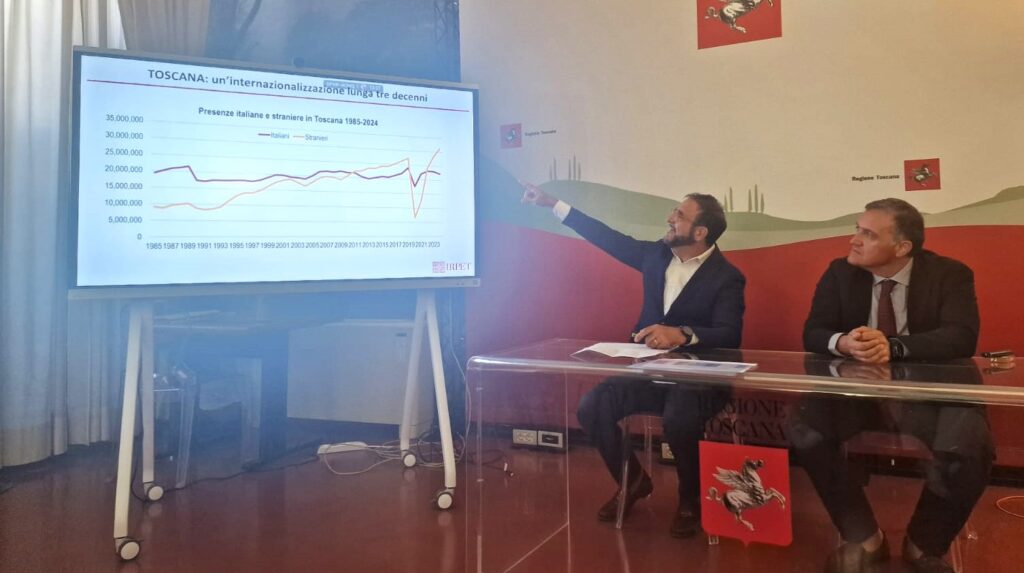
Globally, 2024 will see a further acceleration in international arrivals, which will grow by an additional 140 million compared to 2023 (+11%), closing the gap with pre-pandemic flows. It has therefore taken three years since the pandemic peak in 2021 to return to pre-crisis levels, thanks to the complete lifting of remaining restrictions and the full recovery of international routes. Expectations for the current tourist season are positive. The World Tourism Organization (UNWTO) maintains its forecast of growth in international arrivals between 3% and 5% in 2025, a figure that reflects confidence in the resilience of travel demand despite an uncertain landscape due to new geopolitical challenges and their impact on the global economy. The first quarter of 2025 seems to have confirmed the forecasts to some extent, with a 5% increase in international arrivals.
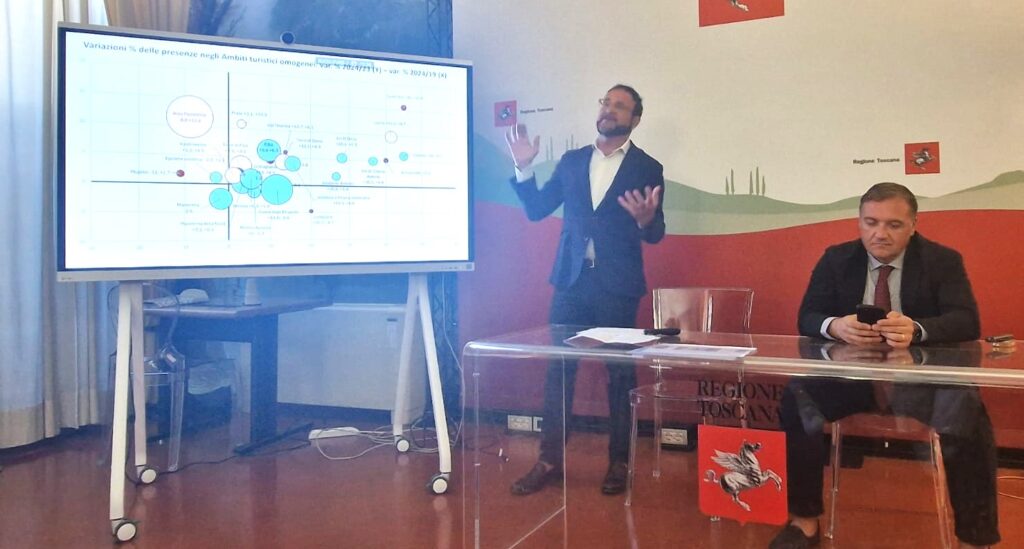
In a national and international context marked by ups and downs, opportunities and challenges, 2024 will be a positive year for Tuscany, with a 5.9% increase in tourist flows compared to 2023 in terms of arrivals and a 4.1% increase in terms of overnight stays. The latter also increased by +4.1% compared to 2019, confirming 2024 as the year of definitive recovery of pre-pandemic flows. The growth in tourist numbers in Tuscany is the result of opposing trends in domestic and foreign markets. The significant increase in foreign visitors (+10.3%), particularly from other continents (+17.5%) but also from Europe (+6.9%), is offset by a decrease in Italian visitors (-3.4%) and, in particular, the domestic segment of Tuscans (-6.1%), while visitors from other Italian regions fell by -2.4%, after an already negative 2023 (-0.5%). The reduction in visitors from southern Italy was compounded by the negative contribution of the main northern regions, traditionally strong customers of Tuscany. (…)
The data used to prepare this Economic Report on Tourism were provided, with regard to movement (presences and arrivals) and accommodation facilities in Tuscany, by the Information Systems and Services Sector – Regional Statistics Office. These data are derived from the “Statistical survey of customer movement in accommodation facilities” and are to be considered provisional until validated by ISTAT, which is responsible for the survey. The data relating to tourism supply come from the statistical survey of “Customer movements in accommodation facilities,” which also records on a monthly basis the number of existing facilities (regardless of whether they are open or closed) and the number of beds, and refer to the average annual value calculated from the monthly data of the existing facilities in each province.
The report was written by Enrico Conti as part of IRPET’s “Local Systems, Culture, and Tourism” research area, coordinated by Sabrina Iommi. The statistical analyses were carried out by Massimo Donati and Valentina Patacchini. The editorial layout was done by Elena Zangheri.
Si ringrazia per la collaborazione il Settore Turismo Commercio e Terziario e il Settore Sistemi informativi e servizi statistici – Ufficio Regionale di Statistica.
You might also be interested in...

Research by E. Conti. Survey conducted by the Center for Tourism Studies. Statistical analysis by M. L. Maitino

Report edited by G. F. Gori, coordinated by P. Lattarulo, in collaboration with the Regional Public Contracts Observatory

Report edited by E. Conti
Annual Report edited by L. Ghezzi and N. Sciclone


