


Cohesion policy at a crossroads. A narrative crisis, an industrial shift, and Tuscany’s strategic positioning in the 2028–2034 negotiations
Position Paper 49/2026 by M. Mariani and N. Sciclone
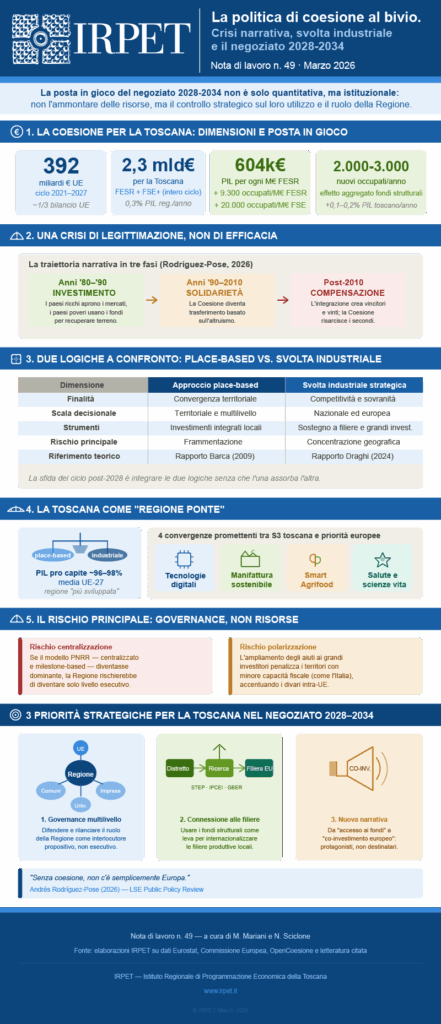
Cohesion policy is the European Union’s main instrument for structural investment. For the 2021–2027 programming period, the EU has allocated €392 billion to cohesion—nearly one-third of the Union’s total budget (European Commission, 2026). In Italy, total resources for cohesion policies amount to €135 billion, of which €43 billion comes from the EU and €92 billion from national co-financing; of this amount, €97 billion is allocated to Southern Italy. On an annual basis, this amount is equivalent to 0.9% of the national GDP (OpenCoesione, 2026).
For Tuscany, the resources from the two main structural funds—the European Regional Development Fund (ERDF) and the European Social Fund Plus (ESF+)—total 2.3 billion euros for the entire programming period, equivalent to 0.3% of regional GDP on an annual basis. Tuscany’s share represents 5.6% of the total distributed among all Italian regions (Ghezzi and Sciclone, 2026). The ERDF largely funds research, innovation, digitalization, and the green transition; the ESF+ focuses on employment, training, inclusion, and active labor market policies. Added to these is the European Agricultural Fund for Rural Development (EAFRD), which in the 2014–2020 cycle constituted the third pillar of Cohesion Policy and which in the current cycle has been brought under the rules of the CAP. Its placement in the next cycle remains open; this note focuses on the main structural funds, but the uncertainty surrounding the EAFRD amplifies the risk profile for regions such as Tuscany (Paniccià et al., 2025b).
You might also be interested in...
Position Paper 51/2026 by L. Ghezzi and N. Sciclone
Position Paper 50/2026 by E. Alberti, S. Duranti, L. Ravagli and N. Sciclone
Position Paper 48/2026 by L. Ghezzi, M. L. Maitino, L. Piccini, and N. Sciclone

Position Paper 47/2026 by S. Duranti and N. Faraoni


